What are mandatory landlord certificates, and does it vary by property?
Mandatory landlord certificates confirm you’ve met legal safety inspection requirements. What’s required depends on the setup of your property. You’ll need different documents based on whether it’s electric or gas, a single let or an HMO, or if there are shared spaces.
Take a fully electric flat. It won’t need a Gas Safety Certificate. But one with a boiler will. If your building has common areas like hallways, extra duties may apply, including a Fire Risk Assessment. It’s also worth remembering that not all legal duties generate certificates. Smoke and carbon monoxide alarms are mandatory, but they don’t come with a document unless part of a fire alarm system.
PAT testing is another good example. While it’s sensible to carry out in furnished properties, it’s not required by law for most residential lets.
| Scenario | Mandatory Certificates |
|---|---|
| Electric-only flat | EICR, EPC, Smoke/CO alarm duty |
| Gas boiler, no fire systems | CP12, EICR, EPC, alarms |
| HMO with shared parts | CP12, EICR, EPC, Fire Alarm Cert, FRA |
Check the official guidance from GOV.UK or the HSE to know exactly what applies to your property type. If you’re unsure what counts as a certificate versus a duty, think of it this way. Duties are legal obligations like having working alarms. Certificates are formal documents that prove you’ve met them.

Here's What We Have Covered In This Article
Which checks can realistically be combined in one visit?
You can book multiple safety checks at once, but it depends on the provider. They need the right qualifications, and the visit must be properly planned.
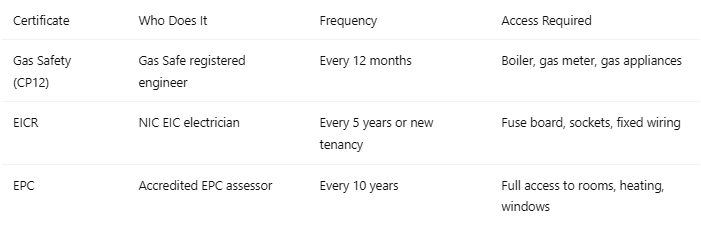
Checks for communal systems like fire alarms or emergency lighting may need additional engineers. Not every provider offers all services, so it’s vital to confirm upfront.
Always ask if the engineer attending can carry out every inspection you need. Without that, the one-visit plan may fall apart. Some firms offer one-stop landlord inspections specifically to avoid this issue.
Pro Tip: Use the gas certificate’s early renewal window to bring all your inspections into sync.
The fastest way to book everything together
Timing matters more than speed. If you rush the booking sequence, you risk multiple visits and tenant confusion.
Follow this plan:
- List the number of bedrooms, whether gas is present, and the fuse board and boiler locations.
- Confirm access is sorted. Either a keyholder or the tenant must be available.
- Confirm legal obligations for your property. Decide whether you need CP12, EICR, EPC, fire alarm testing, or a Fire Risk Assessment.
- Choose a provider that can handle the full list.
- Send written notice to the tenant with date, time, and contact info.
- Clear all access points before the visit.
Don’t book anything until you know someone can open all the doors and cupboards. Most missed visits happen because of access, not the inspections themselves.
How to align renewal dates for one-visit convenience
Renewal drift is a common issue. One certificate runs out in April, another in July, and another later in the year. That creates rebooking headaches.
Gas safety gives you a fix. You can renew it up to two months early without resetting the renewal cycle. This allows you to line it up with your other checks.
Here’s how to sync things:
- Write down all expiry dates.
- Choose a month that suits you.
- Bring your gas check forward to that month.
- Book your EICR and EPC for the same visit.
Say your gas certificate ends in May, your EICR in June, and EPC in August. Book them all in June. That keeps things together for next year.
What to prepare before the inspector arrives
Most failed visits happen because engineers can’t reach what they need. It’s avoidable with a bit of prep.
Areas to make accessible:
- Gas meter and boiler
- Electrical consumer unit
- Smoke and CO alarms
- Loft hatches if they’re part of the check
Before the appointment:
- Unblock cupboards and meter areas.
- Move pets to a safe area.
- Let tenants know that power or heating might go off briefly.
- Keep any past certificates handy if possible.
Even a labelled fuse board can speed things up. These access points form part of your pre-inspection checklist and directly affect whether the visit succeeds first time.

Get a Fast Quote for Combined Inspections
Tell us what you need, and we’ll handle the rest with transparent pricing and qualified engineers.
Tenant or agent access: scripts, notice, and cancellations
You’re sending someone into a lived-in home. A clear, polite message makes all the difference.
Include in your message:
- Two or three time slot options
- The reason for the visit
- The name of the company or engineer
Example script:
We’ve scheduled safety inspections at your property. These include gas, electrical, and EPC checks. Please make sure access is available on [DATE] between [TIME]. The engineer may briefly switch off power or heating. Pets should be secured during the visit.
If a tenant cancels:
- Keep the communication
- Offer new times
- Mention it’s a legal requirement
Tenant’s to-do list:
- Clear access to key areas.
- Secure any animals.
- Be in or leave keys with a trusted contact.
Smooth access protects your timeline and your budget.
Pro Tip: Never book before confirming access with the tenant or agent to avoid wasted visits.
What happens during a combined appointment
Here’s how a combined visit typically runs:
- Engineer arrives and shows ID.
- CP12: boiler and gas appliances are tested for safety.
- EICR: electrics are inspected. Power is turned off briefly.
- EPC: insulation, windows, and heating are reviewed.
- Fire checks (if needed): alarms, lights, and escape routes are examined.
- Reports are sent by email, usually within 48 hours.
Time depends on the property. One-bed flats often take under two hours. Larger homes or HMOs may need most of the day.
If a certificate fails: remedials, re-tests, and letting timelines
A failed inspection doesn’t mean disaster. It means something needs fixing.
Common reasons for failure:
- EICR: damaged wiring, outdated fuse boards, missing RCD protection
- CP12: gas leaks, faulty flues, ventilation problems
What to do next:
- Turn off any unsafe systems straight away.
- Book remedial work as soon as possible.
- Schedule a re-test once the issue is resolved.
- Keep the failed report, repair invoice, and new certificate on file.
Fixing issues quickly protects your ability to let the property. It also keeps insurers and licensing authorities satisfied.
Book All Certificates in One Go
One visit, full compliance. Gas, electrical, EPC and fire checks done efficiently.
What to ask any provider before you book
To make sure it all gets done, ask these five things:
- Are your engineers certified for all the checks I need?
- Can you do them all in one visit?
- How many appliances are included, and are revisits extra?
- When will I get the digital reports?
- Can you handle remedials if something fails?
Get clear answers. The right provider, like Landlord Building Certificates, can save you time, money, and admin.
Build a compliance evidence pack
Having everything in one place avoids stress later. A good landlord compliance pack helps during licensing, renewals, insurance audits, or tenant disputes.
Suggested folder structure:
- /Your Property Address/
- CP12 – June 2026.pdf
- EICR – June 2026.pdf
- EPC – June 2026,pdf
- Fire Alarm Cert – June 2026.pdf
Include:
- A spreadsheet with expiry dates
- Calendar reminders
- Cloud backups for fast sharing
A tidy file means you’re ready when tenants, insurers, or councils ask for proof.
Quick FAQs about combined landlord certificate bookings
Can I renew my gas certificate early and keep the same expiry?
Yes. You can renew up to two months in advance without changing the cycle.
Is PAT testing required by law?
No. Unless your property licence demands it, it’s best practice, not mandatory.
Do I need a new EPC if it expires during a tenancy?
No. As long as it was valid at the start, you’re covered.
What if a tenant refuses access?
Record all attempts. Offer options. If it continues, get legal advice.
Can one provider do it all?
Yes. If they’re fully qualified, confirm before booking.
Do I need a Fire Risk Assessment for a flat?
Only if there are communal areas like shared hallways or staircases. In single-lets with no common parts, it’s usually not required.