What certificates will landlords need for the new database registration?
Landlords are likely to need a clear digital record of the main safety and compliance documents tied to each rental property. In practice, that means having up to date certificates ready for upload, including an Electrical Installation Condition Report (EICR), a Gas Safety Certificate (CP12), an Energy Performance Certificate (EPC), and, where the property type requires them, fire alarm, emergency lighting, and Portable Appliance Testing (PAT) records.

An illustrative image of a property manager viewing digital property certificates
Here's What We Have Covered In This Article
Understanding the new landlord database registration requirement
A central landlord register has been proposed as part of a wider shift in how rental property compliance is tracked. The broad direction is clear: instead of relying only on scattered local records, authorities want a more consistent property database that links landlords, homes, and legal obligations in one place.
For landlords and managing agents, the practical change is straightforward. Registration is expected to become another routine compliance task, alongside keeping certificates current and responding to renewal deadlines. A database of this kind also gives local authorities and other enforcement bodies a quicker way to check whether required documents exist.
A few points matter from the outset:
- The database is about evidence as well as registration. Entering property details is only one part of the process.
- Digital documentation will matter more. Paper records may still have value, but upload-ready files are likely to become the working standard.
- Enforcement risk may become easier to spot. Missing certificates, expired records, or mismatched addresses could be more visible.
- Existing property licensing frameworks may still apply. A landlord register does not automatically replace local licensing duties.
Some landlords assume a new rental property register would affect only large portfolios or licensed HMOs. That is a risky assumption. If registration is linked to private rented sector enforcement, the scope may reach far beyond complex blocks and shared housing. The sensible approach is to treat certificate organisation as part of everyday property management now, before deadlines begin to bite.
Pro Tip: Keep digital copies of all certificates in a cloud folder named by property address for easy access and upload.
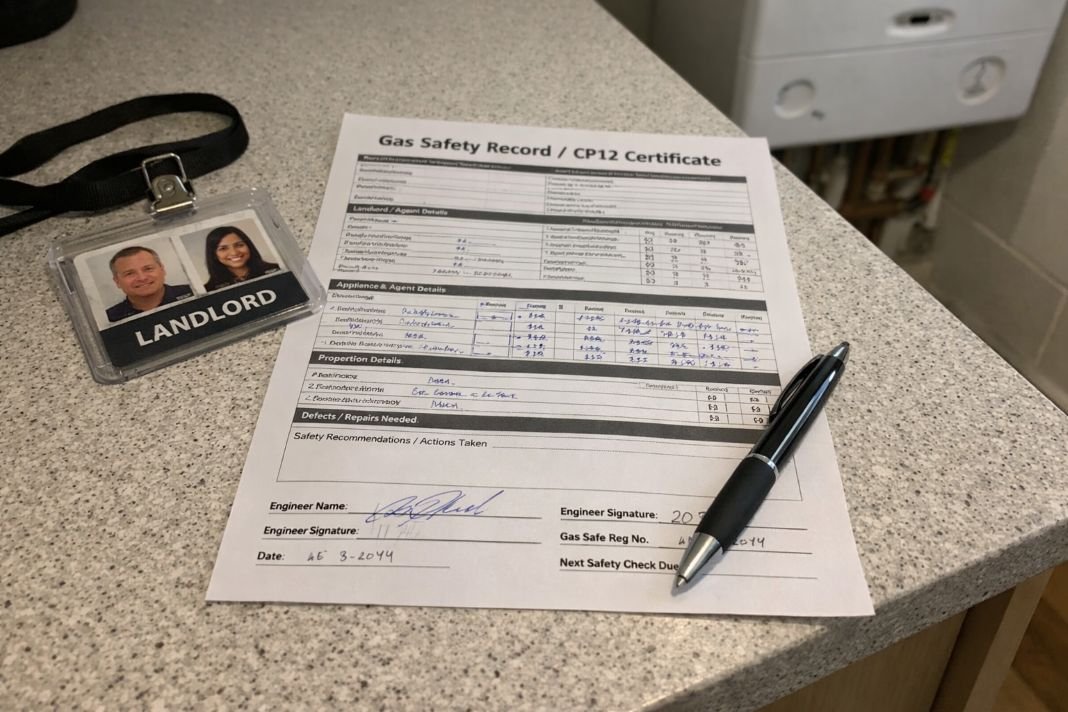
An illustrative image of a Gas Safety Certificate (CP12) on a kitchen countertop
Electrical Installation Condition Report (EICR): What to upload
An Electrical Installation Condition Report (EICR) is the formal record of a periodic inspection of a property’s fixed electrical installation. Under the Electrical Safety Standards in the Private Rented Sector (England) Regulations 2020, many landlords in England already need a valid electrical safety certificate for rented homes.
Before an EICR upload, check these points carefully:
- The report matches the property address exactly.
- The inspection date is visible and the report is still within its validity period.
- The outcome and any observations are clearly recorded.
- The inspector’s details and relevant accreditation are present.
- Any remedial works linked to the report have been dealt with and documented where required.
A common mistake is uploading an invoice, a quotation, or a minor works certificate instead of the actual periodic inspection report. Another frequent problem is using an old electrical certificate that predates later work or does not relate to the full installation. If the database asks for an EICR, it will usually want the report itself, not supporting paperwork on its own.
Most EICRs are valid for up to five years in rented residential property, although a shorter period can be stated on the report. Once an inspector recommends an earlier reinspection date, that shorter interval becomes the one to follow. A landlord who relies on a rough assumption instead of the actual report date can easily end up with an expired document on file.
Accreditation matters as well. An inspection from a suitably qualified electrician, often linked with schemes such as NICEIC or TrustMark, gives the document the credibility that upload systems and enforcement checks are likely to expect. In practical terms, a valid EICR should read as a complete, current record of the property’s electrical condition, not as a loose collection of job sheets.
Gas Safety Certificate (CP12): Uploading the right evidence
A Gas Safety Certificate (CP12) must be current if a rented property has gas appliances, pipework, or flues that fall within the landlord’s responsibilities. The Gas Safety (Installation and Use) Regulations 1998 set the framework, and the inspection must be carried out by an engineer on the Gas Safe Register.
Before uploading a landlord gas safety record, review the document line by line. A valid gas cert should show the property address, inspection date, engineer details, registration number, and the appliances or flues checked. Multi-appliance properties need a record that reflects the whole inspection, not a partial note from a later repair visit.
Annual timing matters here more than in almost any other certificate category. A CP12 does not sit in the background for years. It needs active diary management, especially in properties with several tenancies or handover dates close together. Missing the annual renewal window can create a compliance gap that a central database would make easier to identify.
Landlords often run into trouble with avoidable paperwork issues. The most common examples include uploading a boiler service sheet instead of the gas safety certificate, using a certificate with the wrong address, or storing only a photograph that cuts off the engineer’s details. If the file is hard to read on screen, it is poor upload evidence even if the original paper copy looked acceptable in a folder.
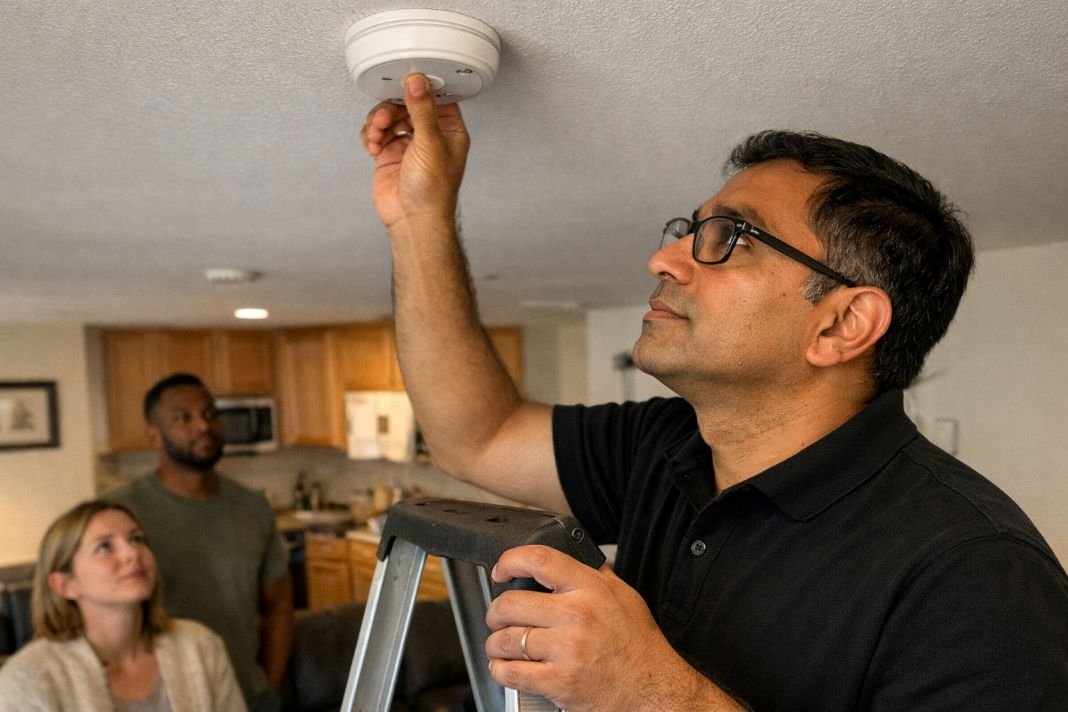
An illustrative image of a professional fire safety inspector doing a smoke alarm check
Energy Performance Certificate (EPC): Digital requirements and deadlines
An Energy Performance Certificate (EPC) shows the property’s energy rating and gives a summary of energy efficiency recommendations. It plays a separate role from safety certificates, but it is still part of the wider compliance picture for letting and marketing property under the Energy Performance of Buildings (England and Wales) Regulations 2012.
For upload purposes, landlords should check:
- the certificate has not expired
- the address matches the rental property exactly
- the rating is visible and legible
- the record can be verified on the EPC Register
- the digital file is complete, rather than a cropped image or partial scan
Most EPCs remain valid for ten years, although a valid certificate on paper does not always answer every compliance issue. Minimum energy efficiency rules in the private rented sector still need separate attention. A landlord can have an EPC that exists, but the rating itself may raise a different legal problem if it falls below the required level and no exemption applies.
Renewal tends to become relevant at familiar trigger points, such as a new tenancy, a sale, or fresh marketing of the property. An older certificate buried in an email archive often causes delays because the file cannot be found quickly, even though the assessment may still appear on the register. That is one reason many agents now keep digital compliance folders for each address rather than relying on ad hoc storage.
Landlord Building Certificates is one of several providers that work within this inspection-led system, where speed of access to the correct document can matter almost as much as the inspection itself.
Order New Compliance Certificates
Arrange inspections and receive valid certificates for electrical, gas, energy, and safety for your rental property, ready for digital upload.
Fire Alarm Certificate: Proving fire safety compliance
A fire alarm certificate is the record used to show that a fire alarm system has been tested, inspected, commissioned, or maintained, depending on the system and the property type. For database purposes, the accepted evidence is likely to be the document that clearly identifies the system, the premises, the test or service date, and the competent person or company responsible.
In many rental properties, the relevant fire safety duties do not look identical. A single let with standard smoke alarms will not always produce the same paperwork as a larger HMO with a more advanced alarm system. Under the Regulatory Reform (Fire Safety) Order 2005 and associated fire risk assessment frameworks, the level of documentation often depends on the building’s layout, use, and management duties.
A useful fire alarm record usually includes:
- The property address and system location.
- The type of inspection, test, or maintenance carried out.
- The date of attendance and any next due date.
- The engineer or assessor details.
- Any faults, variations, or follow-up actions.
British Standards such as BS 5839 are often relevant to how systems are tested and maintained, especially in HMOs and larger premises. Problems usually arise when landlords upload a generic invoice, an alarm installation receipt from years ago, or an incomplete service note that does not confirm the current condition of the system. A proper fire alarm test certificate should read like a present-tense compliance record, not a reminder that work once happened.
Pro Tip: Double-check every document for matching addresses and current dates before submitting to avoid registration delays.
Emergency Lighting Certificate: When and what to provide
Emergency lighting certification is more likely to apply in shared buildings, HMOs, mixed-use premises, and larger blocks where escape routes need backup lighting if the normal supply fails. A standard single dwelling will not always need this document, so the first task is deciding whether the property type and layout create that duty.
BS 5266 is commonly used as the technical reference point for emergency lighting tests and inspection intervals. Licensing conditions for HMOs can also make emergency lighting part of the expected safety setup, particularly in common areas and stairwells.
A simple way to think about it is this:
- If the property has communal escape routes, emergency lighting may be required.
- If HMO licensing conditions mention emergency lighting, certification should be treated as a live compliance item.
- If the building has a maintained or non-maintained emergency lighting system installed, landlords should keep the inspection and test records ready for upload.
The document itself should show what system was tested, where it covers, when the inspection took place, and whether any defects were found. Multi-system properties need records that make sense when viewed remotely by someone who has never visited the building. A vague file name such as “lighting cert final” is not much use if the database reviewer cannot tell which block, floor, or common area it relates to.
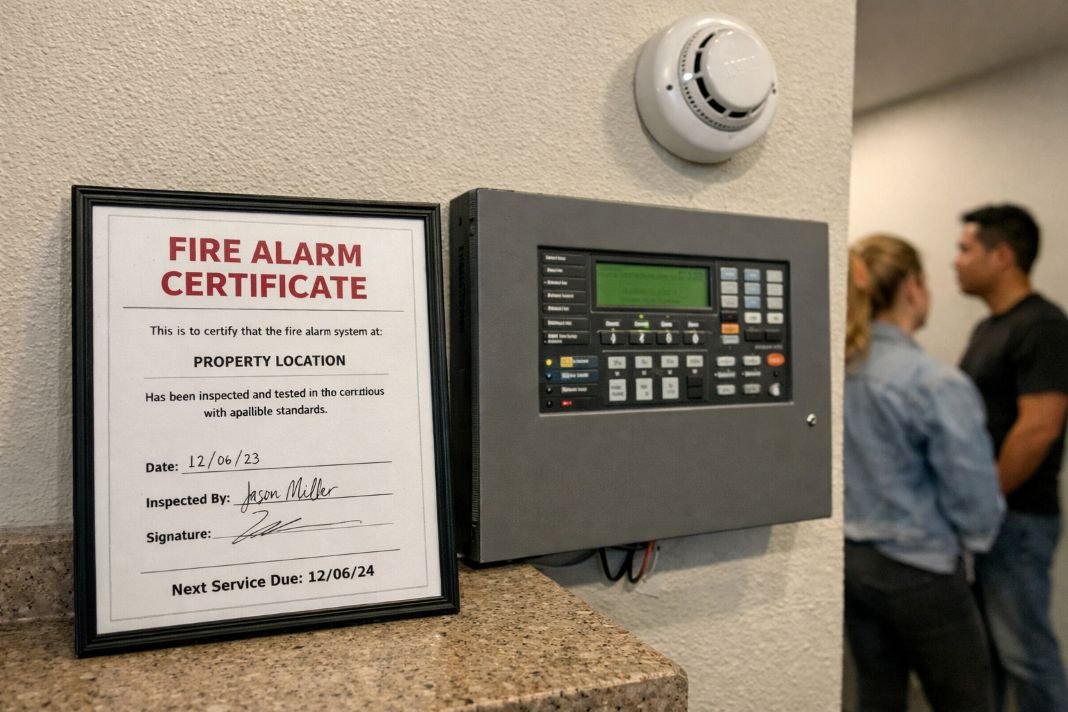
An illustrative image of a fire alarm certificate placed next to a fire alarm control panel
Portable Appliance Testing (PAT): Uploading evidence of electrical appliance safety
Portable Appliance Testing (PAT) applies to movable electrical appliances supplied by the landlord, especially in furnished lets, HMOs, offices, and other settings where landlord-provided equipment is in use. The legal position is usually framed through general electrical safety duties and workplace safety principles, including the Health and Safety at Work Act 1974 in some settings, rather than a blanket rule that every rented home needs an annual PAT certificate.
What matters is the actual appliance inventory. A kettle in a furnished shared kitchen, a microwave supplied with the tenancy, or a landlord-owned extension lead in a communal area may all need to be inspected and tested as part of a sensible safety regime. Tenant-owned appliances are different, because they do not usually sit within the landlord’s provided equipment list.
For upload purposes, useful PAT evidence often includes:
- a PAT certificate or report linked to the property
- an appliance list or inventory reference
- test dates and results
- failed items removed or repaired
- labels or item IDs that match the written record
Confusion often starts when landlords assume PAT is irrelevant because the property itself has a valid EICR. The two records do different jobs. The EICR covers the fixed installation. PAT testing concerns portable appliances that tenants may plug in and use daily. A database that asks for appliance safety evidence is likely to expect exactly that distinction.
Renewal frequency varies with use, wear, and property type. A lightly used lamp in a single let may not need the same test interval as heavily used communal appliances in a busy HMO, so the paperwork should reflect a reasoned inspection schedule rather than guesswork.
Preparing for upload: Common pitfalls and how to avoid them
Once certificates exist, the next challenge is making sure they are actually suitable for digital submission. Many registration delays come from document handling errors, not from the inspection itself.
The usual pitfalls are familiar. An EPC may still be valid, but the file name gives no clue which property it belongs to. A gas safety record may be current, but the uploaded scan cuts off the bottom of the page. An EICR may be genuine, but the address on the report does not match the address entered into the landlord database system.
A tidy upload process usually depends on a few habits:
- keep one digital folder for each property
- name files by certificate type and date
- check expiry dates before registration starts
- use full PDF copies where possible
- review address details for exact matches
- separate current certificates from historic records
Property-specific requirements deserve extra attention. A standard flat may need fewer records than a licensed HMO or a building with communal systems. Fire alarm and emergency lighting documents are often missed because landlords focus on the better known certificates first and only later realise the property type changes the compliance picture.
Landlord Building Certificates operates in the part of the market where these records are gathered and renewed as routine operational documents, which means that organised documentation can save as much time as the inspection visit itself.
The wider lesson is simple. A landlord register is likely to reward orderly record-keeping and expose gaps that were once easy to overlook. Landlords who keep current, readable, property-specific certificates in digital form will be in a far stronger position when registration becomes part of everyday compliance.